Priest
Period - Ultra-Contemporary
Context - Late-capitalist visual culture / Early conditioning of aspiration
Cultural Signal - Brand normalisation, authority imagery, learned desire
Medium - Painting / Installation / Sculpture
Language - Childlike figuration, exaggerated scale, cardboard staging
Priest works with the visual language of childhood, but not to celebrate innocence. His practice draws on the aesthetics of early drawing: felt-tip outlines, uneven colouring, notebook paper, cardboard constructions, pushpins left exposed. At first glance, the works resemble something made in a primary school classroom. Smiling suns. Cartoon animals. Playground scenes.
Look closer, and the imagery shifts.
Take a look at a JD Sports storefront, which appears in a childlike street scene.
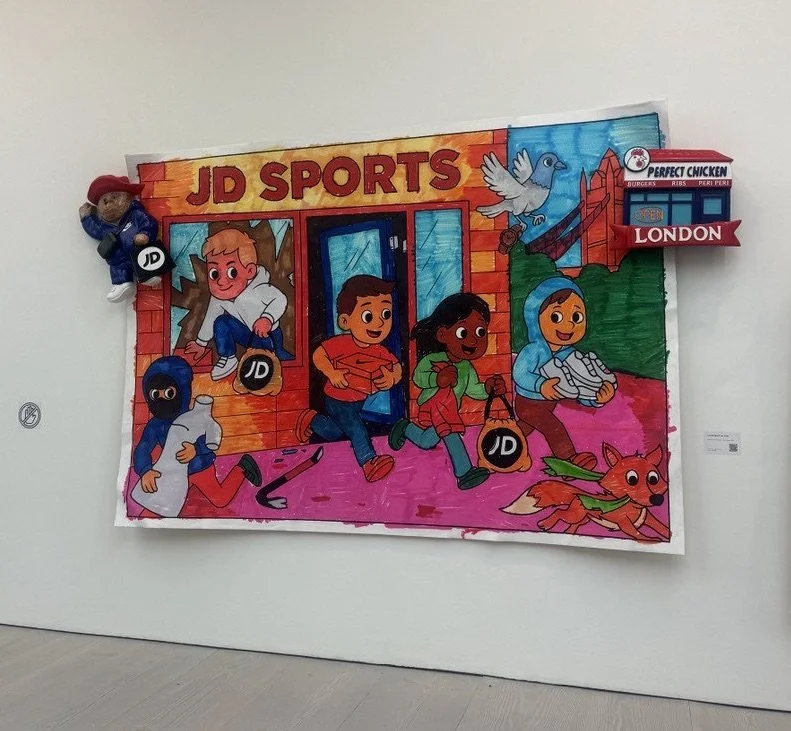
Priest, Chain Reaction (2025), installation view, Saatchi Gallery, 2025. Photo: Art & Butter.
Or at a young figure standing proudly beside money bags and a luxury car, where a Bitcoin symbol replaces a piggy bank.
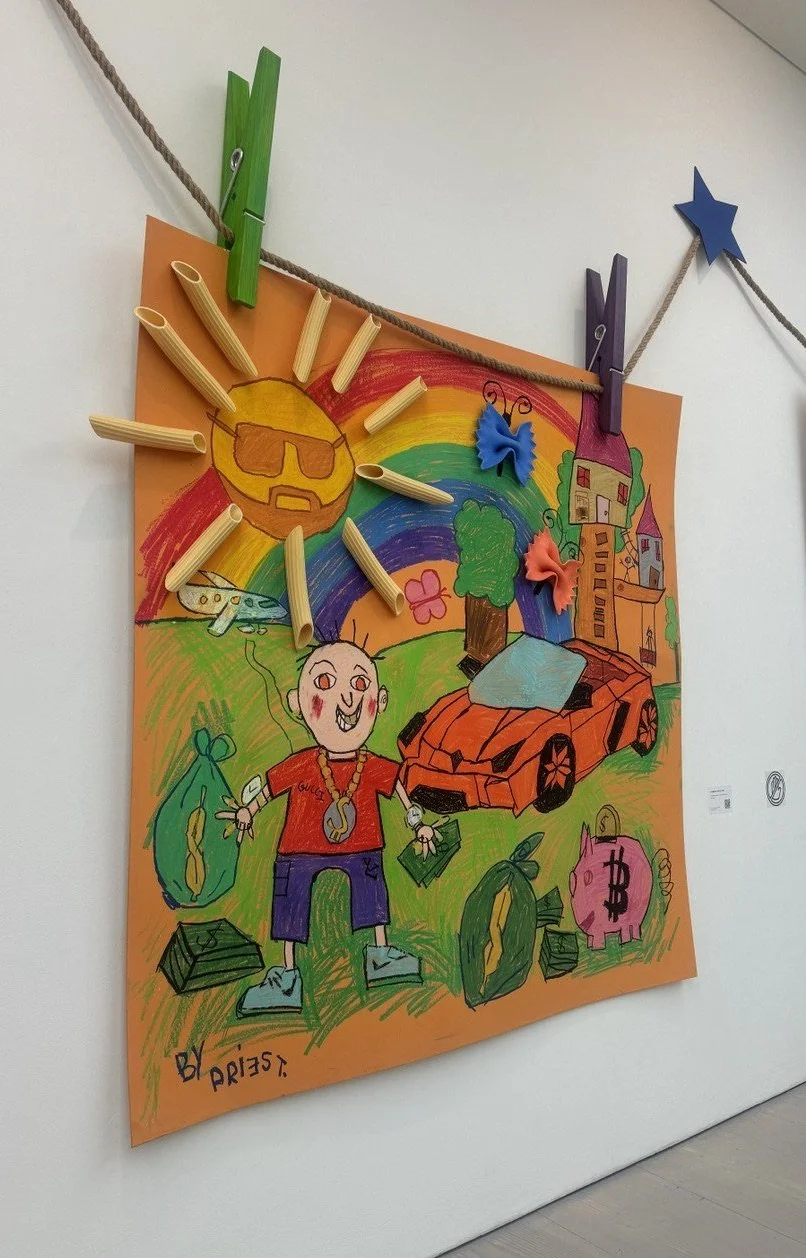
Priest, Lambo by Age 10 (2025) , installation view, Saatchi Gallery, 2025. Photo: Art & Butter.
Or maybe where police officers gather outside a brightly coloured house while helicopters hover above.
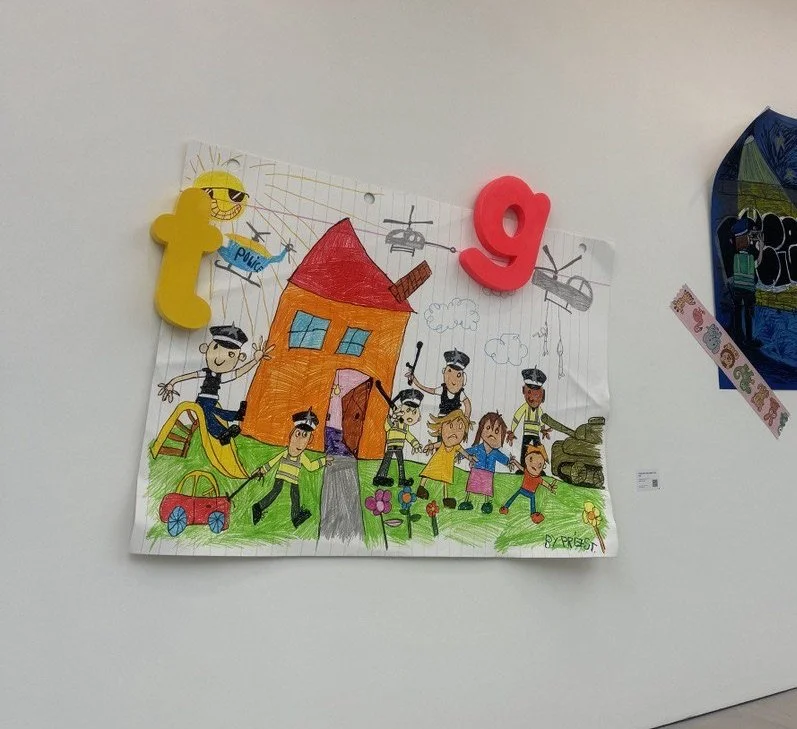
Priest, Community Engagement Day (2025), installation view, Saatchi Gallery, 2025. Photo: Art & Butter.
While the colours are cheerful, childlike and at first glance bring nostalgia, the subjects are not. Priest’s strength lies in this contrast. He adopts the visual grammar of childhood's simplicity, exaggeration, brightness and fills it with the symbols of contemporary life: branding, authority, wealth, surveillance, and aspiration.
The effect is unsettling precisely because it feels familiar.
In recent installations, he extends this language into space. Oversized crayons lean against gallery walls. Cardboard theatre boxes frame cut-out figures suspended on strings. Rulers, glue sticks and pasta shapes become sculptural elements. The materials are deliberately humble. Nothing is polished. Tape is visible. Paper curls at the edges.

Priest, Free Mobile, installation view, Saatchi Gallery, 2025. Photo: Art & Butter.
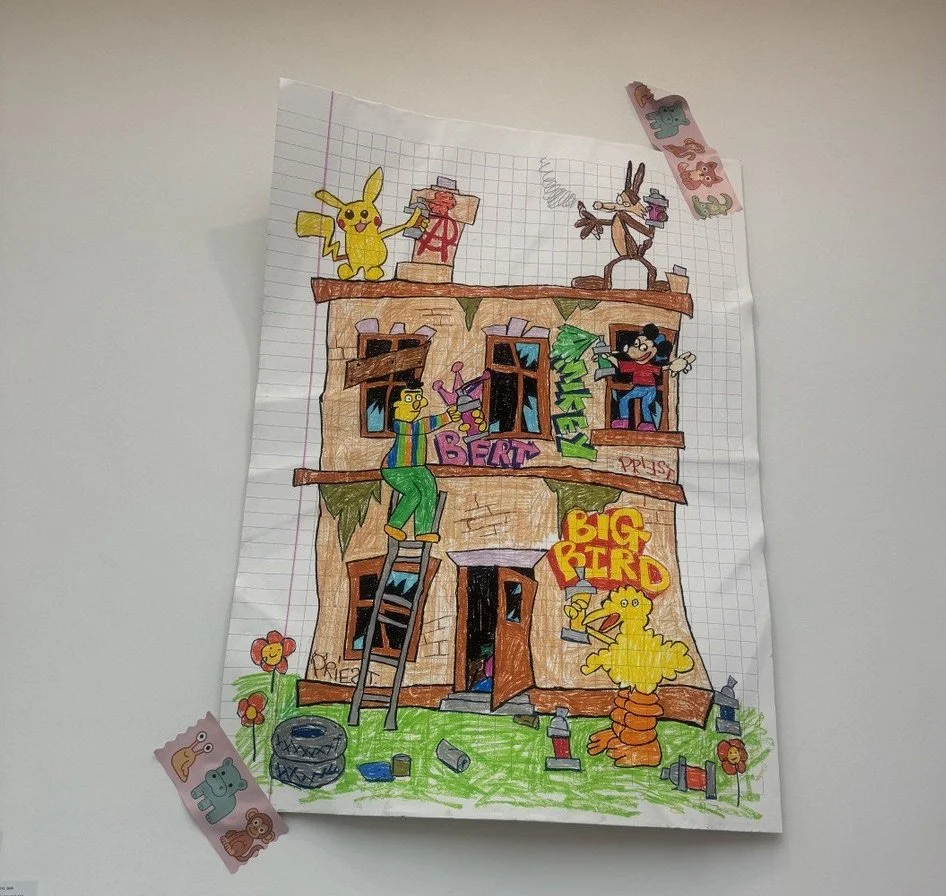
Priest, The Cost of Creation (2025), installation view, Saatchi Gallery, 2025. Photo: Art & Butter.
This staging reinforces what runs through his work, suggesting that systems are learned early.
Capitalism does not begin in the boardroom. It begins in the playground imagination. Logos appear before ideology is understood. Authority becomes normal before it is questioned. Wealth is pictured as a fantasy long before it is analysed as a structure.
Priest does not approach these themes with aggression. There is no dramatic collapse, nor is there an overt protest. Instead, he presents a world that looks playful, almost sweet and allows the discomfort to surface slowly.
Why now? Because Priest’s practice reflects a broader cultural condition: the early normalisation of branding, authority, and aspiration. His work does not dramatise power; it shows how quietly it is learned.
The child’s drawing becomes a diagram of adult society.
And in that translation, something shifts.
Because the scenes he constructs are not exaggerated versions of reality.
They are simplified ones.
Which makes them harder to ignore.