
Julian Charrière
Period - Ultra-Contemporary
Context - Contemporary multidisciplinary practice exploring geology, climate, extraction, and the environmental histories embedded within landscapes
Cultural Signal - Reframing the planet as a living archive where geological time, colonial histories, and human intervention intersect
Medium - Film, photography, sculpture, installation
Language - Deep time, fieldwork, geological processes, environmental memory, extraction, scientific inquiry, immersive landscapes
Swiss-French artist Julian Charrière (b. 1987) lives and works in Berlin. Working across film, photography, sculpture, and installation, Charrière investigates the invisible relationships between humanity and the Earth's geological systems. Through extensive field research in glaciers, volcanoes, nuclear test sites, deep-sea ecosystems, and remote polar landscapes, he transforms scientific observation into poetic encounters that reveal the fragile intersections of nature, history, and culture. Rather than presenting landscapes as passive scenery, Charrière approaches them as living archives, bearing the physical traces of environmental change, colonial exploration, industrial extraction, and human ambition.
His recent exhibition, Hard Core, exemplifies this approach by inviting audiences to encounter time on a geological scale. Bringing together sculpture, photography, film, and installation, the exhibition considers the immense forces that have shaped the Earth over billions of years while questioning humanity's comparatively brief presence within them. Rather than positioning environmental issues as distant catastrophes, Charrière encourages viewers to experience them physically, allowing scientific phenomena to become sensorial and deeply personal.
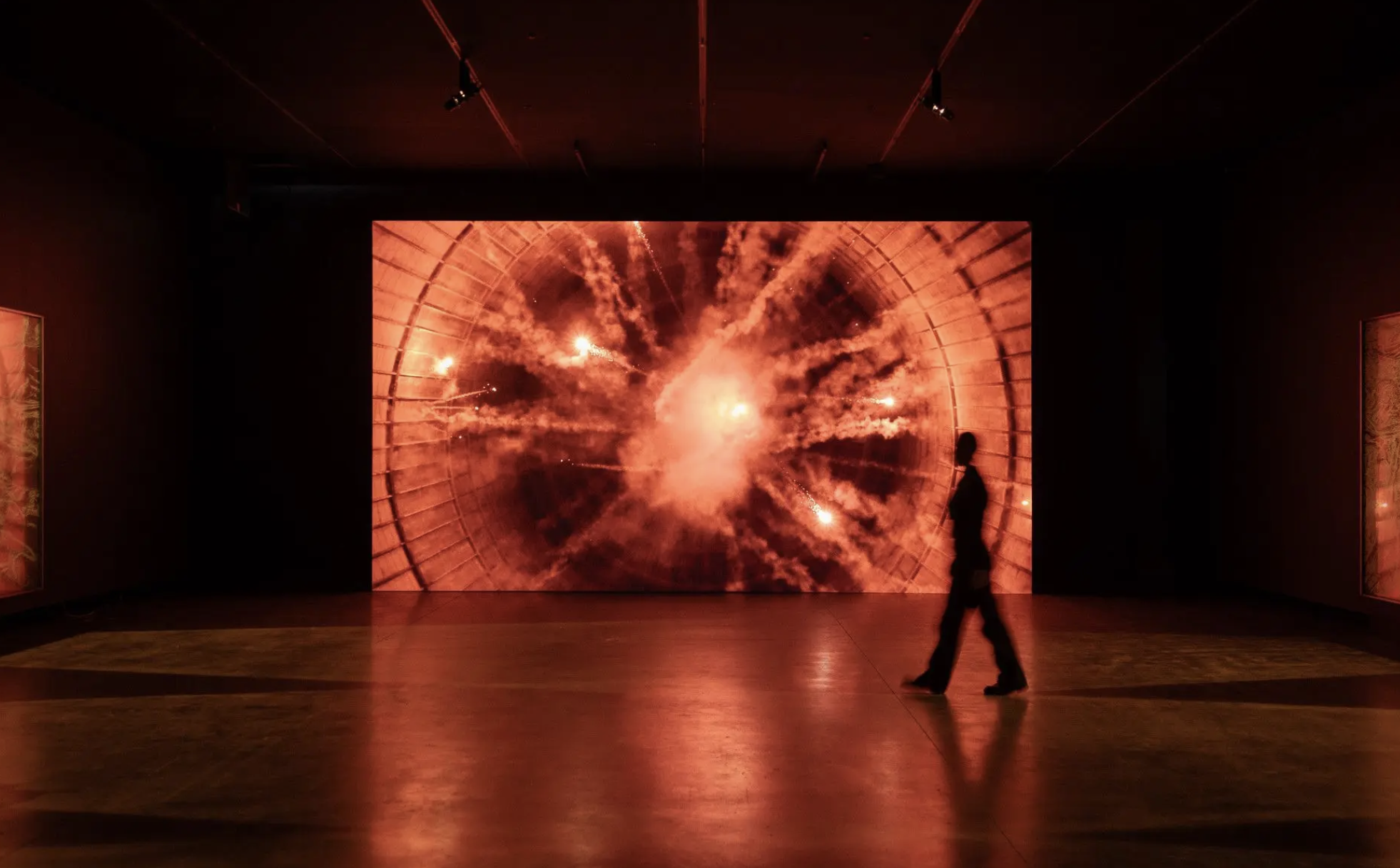
Julian Charrière, Controlled Burn (2022), installation view, Mona, 2026. Courtesy of the artist.
At the centre of the exhibition is Breathe, a site-specific installation embedded within the museum itself. Using a scientific process, the work releases oxygen molecules trapped inside banded iron ore since the Great Oxidation Event approximately 2.4 billion years ago. Visitors inhale air that has remained sealed within the Earth's crust for billions of years, collapsing unimaginable stretches of geological time into a single breath. The work transforms an invisible planetary process into an intimate bodily experience, reminding us that our existence remains inseparable from the deep histories of the Earth beneath our feet.
Throughout Charrière's practice, scientific research and artistic imagination exist in constant dialogue. His expeditions to volcanic landscapes, Antarctic ice fields, and threatened marine environments do not seek to document nature objectively, but instead reveal the complex cultural narratives embedded within these places. Landscapes become repositories of memory where environmental transformation, technological progress, and colonial histories continue to shape one another. By slowing perception and extending our temporal horizon beyond human lifespans, Charrière asks viewers to reconsider their relationship with the planet—not as detached observers, but as participants within vast ecological systems that both precede and will outlast us.
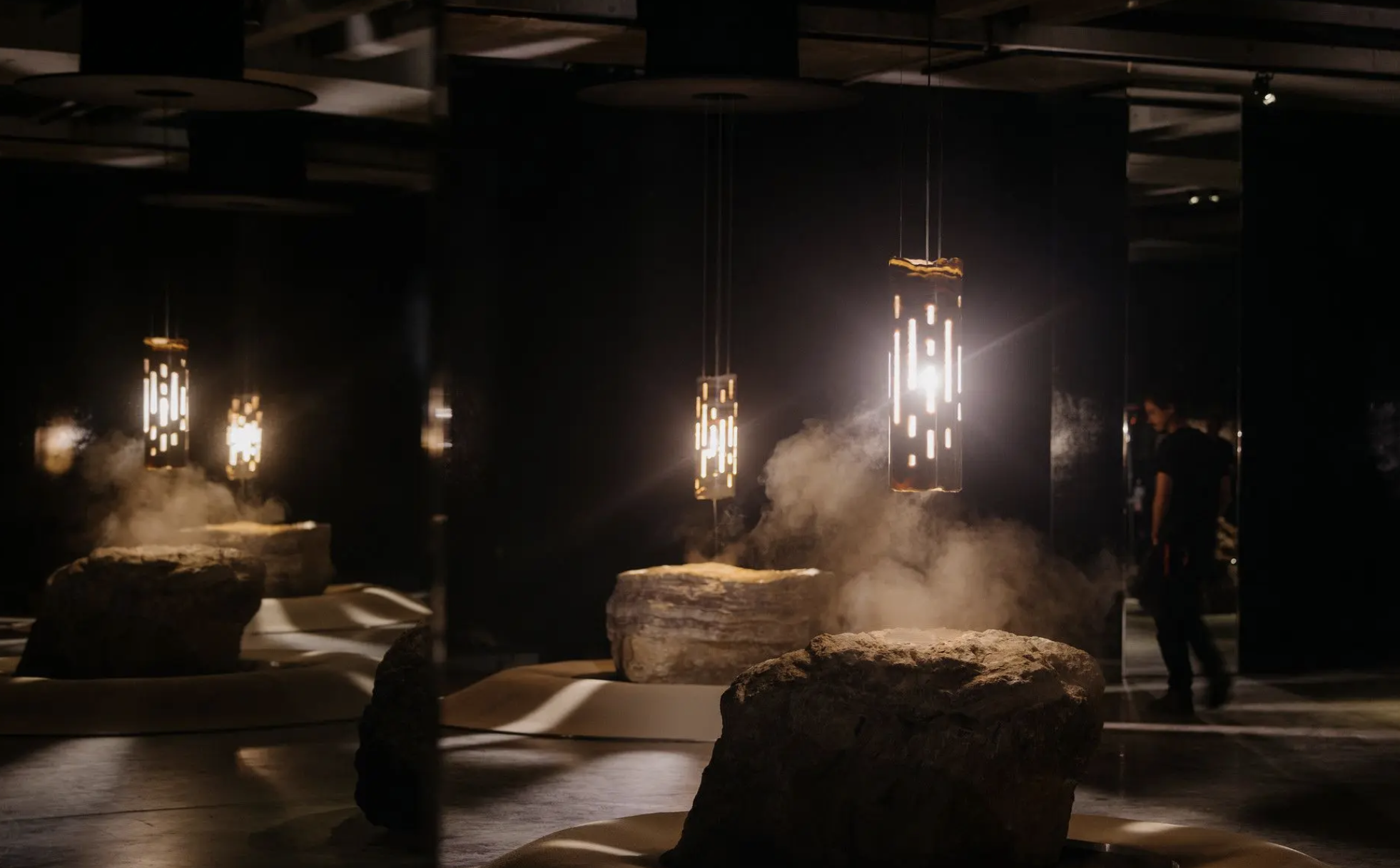
Julian Charrière, Vertigo (2021), installation view, Mona, 2026. Courtesy of the artist.
His work reflects a growing movement in contemporary art that moves beyond illustrating climate change towards reshaping how we experience planetary time itself. Through immersive installations and carefully orchestrated encounters with elemental materials, Charrière demonstrates that geology is not simply the study of rocks but a record of life, memory, and human consequence. His practice ultimately reminds us that the Earth is never static; it is a living archive whose deepest histories continue to unfold beneath every step we take.
Why now?
As contemporary artists increasingly address the climate crisis, extractivism, and environmental responsibility, Julian Charrière offers a perspective that extends beyond immediate ecological concerns into the vast timescales of planetary history. By combining scientific inquiry with poetic imagination, his work encourages audiences to rethink humanity's place within deep geological time, reminding us that today's environmental decisions will become tomorrow's archaeological record.
Biographical information sourced from the artist’s official website.