
What Actually Affects the Price of a Painting?
When a painting sells for a very high price, our instinct is usually to assume that it reflects its beauty or artistic importance. However, as all of us have different tastes and preferences shaped by our experiences, we often question how a seemingly “simple” or “unskilful” work can reach such value. In both cases, the appearance of the work is only a small fraction of its price. Many other factors influence its worth — some obvious, while some are less visible.
Artist
Perhaps the most obvious factor is the author of the work. Established and recognised artists tend to sell for higher prices, as their name functions almost like a brand. However, it has become increasingly evident that emerging artists can also add significant value to their works — especially with the right positioning and marketing. There is also a common belief that artists become more valuable after death. While this is sometimes true, it is less about sudden appreciation and more about supply and demand: once an artist is no longer producing work, the supply becomes fixed, naturally increasing scarcity and, in turn, price.
Size
As a rule, the smaller the work, the less expensive it is, except for paintings and sculptures that may be too large for domestic installation, and they become harder to sell.
School | Craftsmenship
While not always essential, formal training or association with a recognised school can add perceived professionalism and credibility, influencing value.
Material
When thinking about material, we often focus only on the visible paint layer — oil, acrylic, or other mediums. Yet the value of a painting is also shaped by what lies beneath: the support (canvas, wood, or alternative materials), preparatory layers, and varnish. These elements are not only important for value but also for authenticity. In many cases, material analysis plays a key role in verifying a work. For example, Old Master paintings are expected to contain historically accurate materials, whereas replicas often fail to replicate these details due to the use of new materials that did not exist at the time of creation of the painting.
Condition
Condition plays a crucial role in valuation. Visible damage generally reduces value, while minor or less noticeable deterioration may have a limited impact. However, there are exceptions. Damage that carries historical or symbolic meaning — for instance, linked to a significant event or figure that damaged it can sometimes enhance a work’s narrative and, in rare cases, its value.
Labels | Marks | Signatures
It should be obvious that when the work is signed or labelled by the artist, it not only adds authenticity but ultimately increases the price of the work. Yet, given the high amount of forgery, it is essential to not only check the stylistic factor of signatures, but also the material they were created with.
Narrative
Just like any other products or services, paintings are rarely sold as isolated objects, but as carefully advertised entities. They are presented through carefully constructed stories. Auction catalogues, for instance, use various marketing techniques to combine art historical context with persuasive language designed to evoke emotion and urgency. Descriptions often emphasise rarity, importance within an artist’s career, or connections to iconic subjects, shaping how collectors perceive the work before they even encounter it in person. This emotional framing actively drives desirability and, ultimately, willingness to pay.
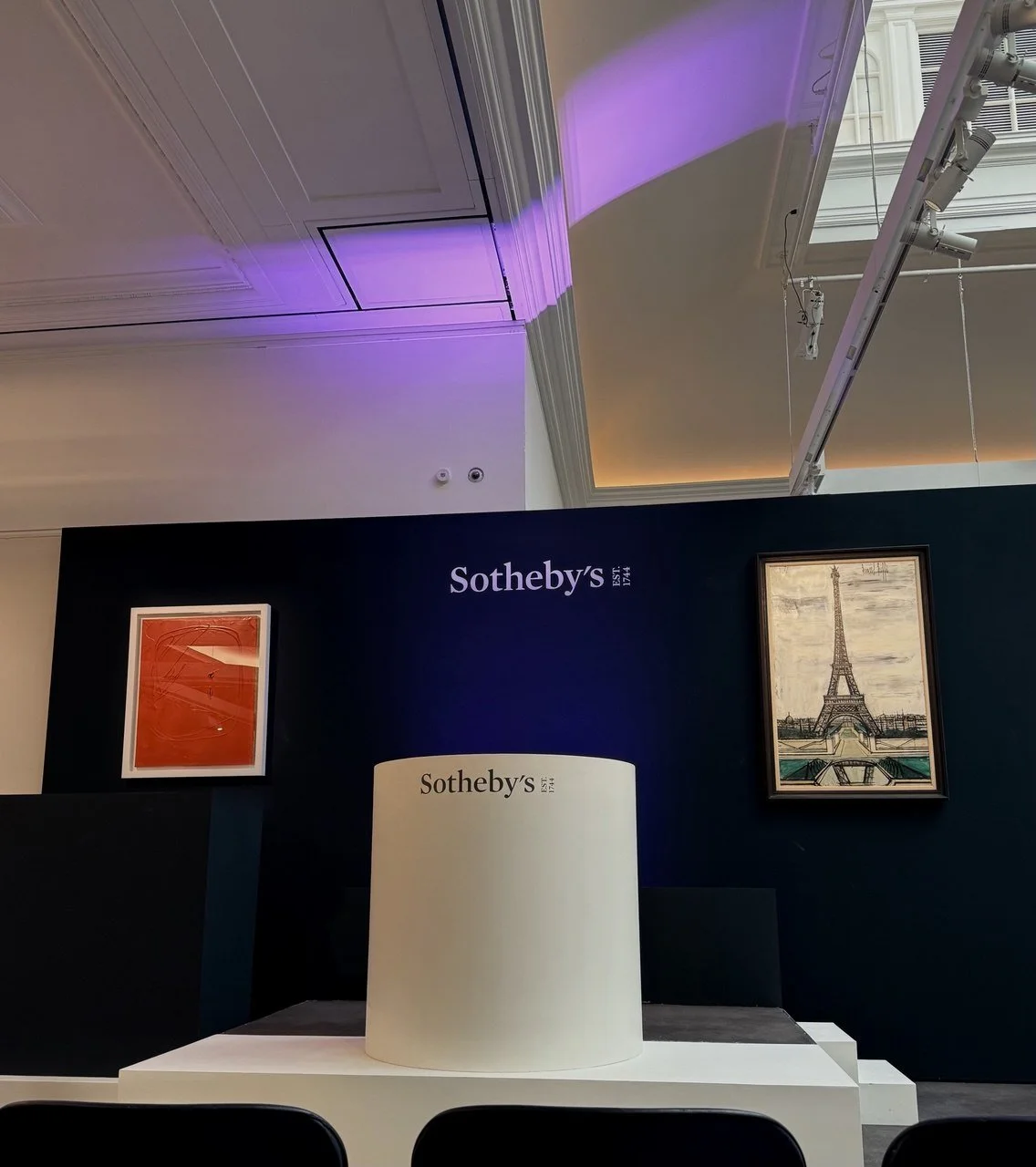
Installation view, Sotheby’s, 2025. Photo: Art & Butter.
Visual Presentation
Closely tied to narrative, presentation acts as a supporting force. High-quality images, exhibition-style layouts, and comparative illustrations all contribute to how a painting is experienced. Much like luxury branding, presentation enhances perceived value. A painting positioned within a curated visual and intellectual context appears more significant, more desirable, and more 'collectable.'
Provenance | Exhibition History
Perhaps one of the main factors, that usually does not seem apparent. Works that have passed through the hands of influential collectors, dealers, institutions or anyone famous carry an added layer of cultural and symbolic capital. This is sometimes referred to as “celebrity provenance,” where association with well-known figures enhances both trust and desirability. Furthermore, exhibition history also adds institutional credibility, positioning the work within a recognised cultural framework. Collectors are not only buying the artwork, but also buying the history and the prestige attached to it. On the other hand, works that entered directly from a primary market can also increase the price and allow the buyer to become part of that history themselves.
Comparables
Auction houses rely on previous sales of similar works to establish estimates, creating a framework that anchors expectations. However, comparables are not neutral benchmarks. Two visually similar paintings can achieve vastly different prices depending on factors such as provenance, timing, or the context of the sale. A work offered in a high-profile, single-owner auction, for example, may perform significantly better than one sold anonymously, even if their artistic qualities are comparable.
Scarcity | Subject matter | Artistic Movement
Scarcity plays a major role. Works from limited series, featuring recognisable subjects, or belonging to celebrated periods tend to attract stronger demand. At the same time, collectors often seek uniqueness, something that differentiates their acquisition from others. Scarcity creates competition, and competition drives price.
Catalogue raisonné
Inclusion in a catalogue raisonné is crucial for authentication. It can determine whether a work holds significant value or remains obscure. Exclusion, on the other hand, can severely limit resale potential, as major auction houses often refuse unlisted works.
Market Conditions
Finally, what's important to remember is that despite any factors, economic uncertainty, shifts in collector taste, and changes in global buying power all influence how artworks are valued at any given moment. Even the most established artists are not immune to these fluctuations; their markets expand and contract alongside wider financial and cultural trends, which is why many advisors suggest buying works that align with your preferences and taste, rather than buying work for a possible financial profit.
In the end, the price of a painting is not a fixed truth but a negotiation between meaning and market. It reflects not only what the artwork is, but how convincingly it is positioned: culturally, historically, and emotionally within the systems that define value.