
Photography & Painting: A Different Kind of Truth
Photography and painting have long been positioned in opposition starting from the 19th century and early 20th century. The first time photographs were shown in France was at the 1875 Salon, alongside paintings and sculptures, while the daguerreotype (the first publicly available commercial photographic process) was invented in 1839. Yet a figure like Alfred Stieglitz (American photographer) still felt rejected for his medium in 1917, although there is no record of photography being rejected.
The key turning point in photography goes back to Louis Daguerre, the inventor of the daguerreotype, where Paul Delaroche (French artist) supported Daguerre in the early reception of photography, positioning it as a medium capable of fulfilling the essential aims of art with unprecedented precision. Photography became understood not only as a technical invention but as a challenge to painting, particularly in regard to being able to represent reality more accurately. A debate arose — is photography capable of showing “how things really look” in a way that could not be bettered? Within this context, the concept of “visual truth” became central. Movements like the Pre-Raphaelites in Britain and the United States wanted to change traditional art. They focused on observing the world directly instead of following old artistic rules. These artists argued that painting should represent what is actually seen, rather than an idealised or stylised version of reality. For example, American Pre-Raphaelite painters, including William Mason Brown and John William Hill, exemplified this approach through highly detailed and precise representations of the visible world. Further, photography introduced a new standard against which painting was measured, where the highest praise for a painting became its resemblance to a photograph, suggesting a complete fidelity to visual reality. However, this also raised a critical question: if photography could effortlessly achieve such accuracy, what is the role of the painting? The camera, in this sense, was understood to present only what the eye perceives, establishing a standard for “visual truth.” Consequently, the relevance of art shifted toward interpreting and demonstrating what visual truth means in any given instance, rather than merely replicating appearances.
The 19th-century painters increasingly came to understand “visual truth” through the lens of photography, despite the fact that photographic images often differ from natural human perception. The work of Eadweard Muybridge (English photographer) exemplifies this shift. His photographs of horses in motion revealed details such as the positioning of hooves during a gallop that the human eye cannot ordinarily perceive.
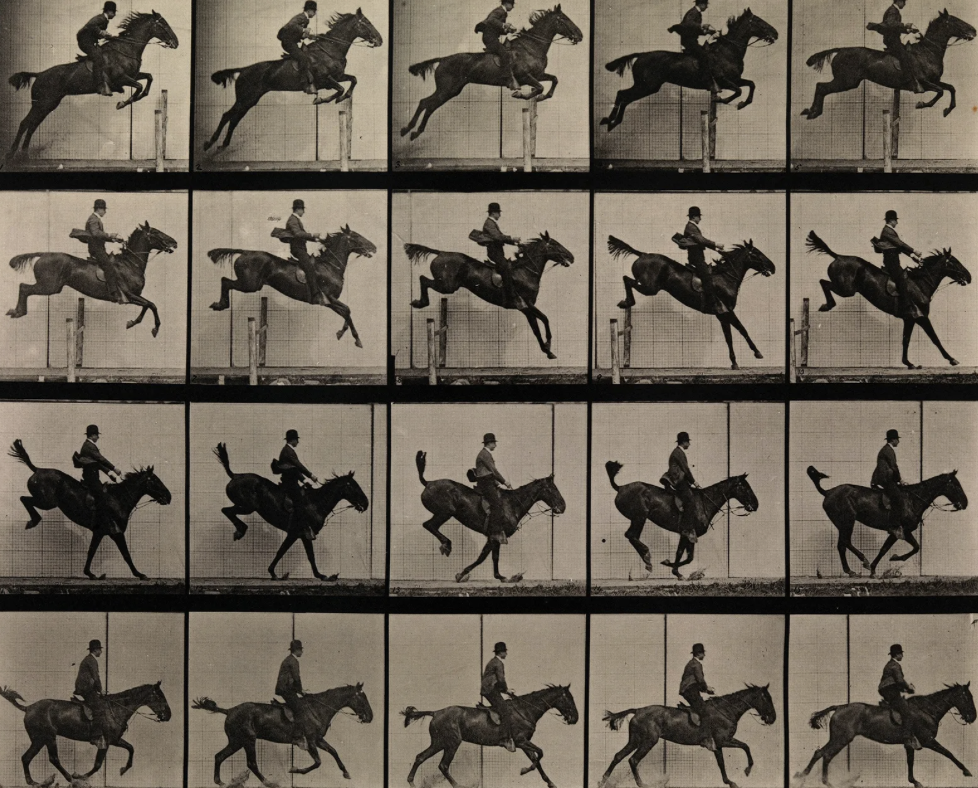
Eadweard Muybridge, Animal Locomotion, Plate 637 or 640 (1887).
Painters subsequently adopted these photographic representations as authoritative, incorporating them into their own work, even though such images did not correspond to how movement is actually experienced visually. Muybridge’s experiments were designed precisely to capture phenomena beyond human perception, thereby establishing photography as a tool for revealing “optical truth.” His images significantly influenced artists such as Edgar Degas (French artist), who at times depicted movement in ways that appear unnatural but align with photographic evidence. Degas himself suggested that photography teaches viewers how to see, even when its results contradict intuitive visual experience. However, this development blurred the distinction between optical accuracy and visual truth, as what is mechanically correct is not always perceptually convincing.
A similar tension emerged in portraits. It is often overlooked that photography is capable of capturing "transitional expressions" which are moments “between” recognisable emotions not visible to the eye. As a result, photographic portraits often appear unfamiliar or unrepresentative to viewers, who compare their image to the one they see in the mirror in real life. Hence, modern photography captures brief moments instead of just recording what is real, and this process creates images that are very different from those made with traditional painting.
Photography played a role in the transition from traditional to Modernist representation through a reconsideration of pictorial space. Clement Greenberg (American essayist) argued that the defining essence of painting lies in its flatness, understood as the rejection of illusionistic depth that had characterised Western painting, for which he positioned Édouard Manet (French artist) as the originator of Modernism, suggesting flatness rather than creating the illusion of three-dimensional space. Hence, it can be said that photography did not merely coexist with painting but actively contributed to its redefinition. By assuming the function of representing visual reality with precision, photography effectively displaced painting’s traditional role in illusionistic representation. As a result, painting was compelled to redefine its purpose, leading to the emergence of Modernist practices that emphasised surface, medium specificity, and formal properties over the depiction of spatial illusion.
The history of Modernism can be understood, following Clement Greenberg, as a progressive narrowing of the spatial distinction between foreground and background, culminating in the assertion of pictorial flatness. While painting increasingly acknowledged the camera’s superiority in capturing visual truth, it simultaneously maintained its own unique features. Unlike photography, which mechanically records what is present before the lens, painting is not bound to reproduce existing appearances and can instead construct its own forms of truth through imaginative interpretation.
The eventual acceptance of photography as an art form emerged alongside the development of Modernism, which caused earlier debates about its artistic status to become increasingly irrelevant. As artistic practice moved away from competing with photography in terms of visual accuracy, it embraced a broader, post-Greenbergian position that validated diverse techniques and sources, including those drawn from everyday visual culture.
Photography had initially been denied the status of art largely because it appeared to eliminate the defining qualities of painting, particularly manual skill and the expressive role of the artist’s hand. The mechanical nature of the camera reduced artistic production to the act of pressing a button, thereby causing both the hand and, ultimately, even the eye to be seemingly irrelevant. The constant changes and superiority between the mediums prolonged the change, where the focus of art has moved away from traditional aesthetic standards toward a broader and more philosophical understanding. It is now understood that the meaning and significance of art are not solely based on visual qualities, but rather on the conceptual framework used to interpret the objects.
So perhaps the question was never whether photography could replace painting. Instead, it made us realise that art was never just about copying what we see. Photography changed the rules, but in doing so, it also gave painting the freedom to become something else. Today, both mediums exist not as competitors, but as different ways of thinking about reality. And maybe that is the point: what we see is never just what is there, but how we are taught to look.
Based on Arthur C. Danto’s What Is Art?