
Symbols as a Way of Interpreting Art (Part 3): Birds
Birds appear throughout the visual traditions of the world, carrying meanings that range from power and wisdom to immortality and spiritual transformation. Their ability to move between earth and sky has often made them symbols of divine communication, freedom, and transcendence. Here, we propose some of the most enduring bird symbols found in art.
Dove
The dove is one of the most universal symbols of peace, purity, and the human soul. It appears in some of the earliest known civilisations, often accompanying powerful fertility goddesses such as Inanna in Mesopotamia. In Greco-Roman mythology, the dove was associated with Aphrodite (Venus), the goddess of love. In China during the Han dynasty, doves symbolised wellbeing and longevity, while in Japan they became associated with harmony and unity. In Christian art, the dove commonly represents the Holy Spirit where early Christian tombs often depicted a dove carrying an olive branch, symbolising a soul at peace in heaven.
Eagle
The eagle has long symbolised power, authority, and divine protection. It was the most important emblem of the Roman emperors and their armies, whose military standards often featured the bird. The Romans regarded the eagle as sacred because it was associated with Jupiter, the king of the gods. In Greek mythology, the eagle was similarly linked to Zeus, serving as his attribute. Across many cultures, the eagle's ability to soar above all other birds established it as a symbol of leadership, sovereignty, and strength.
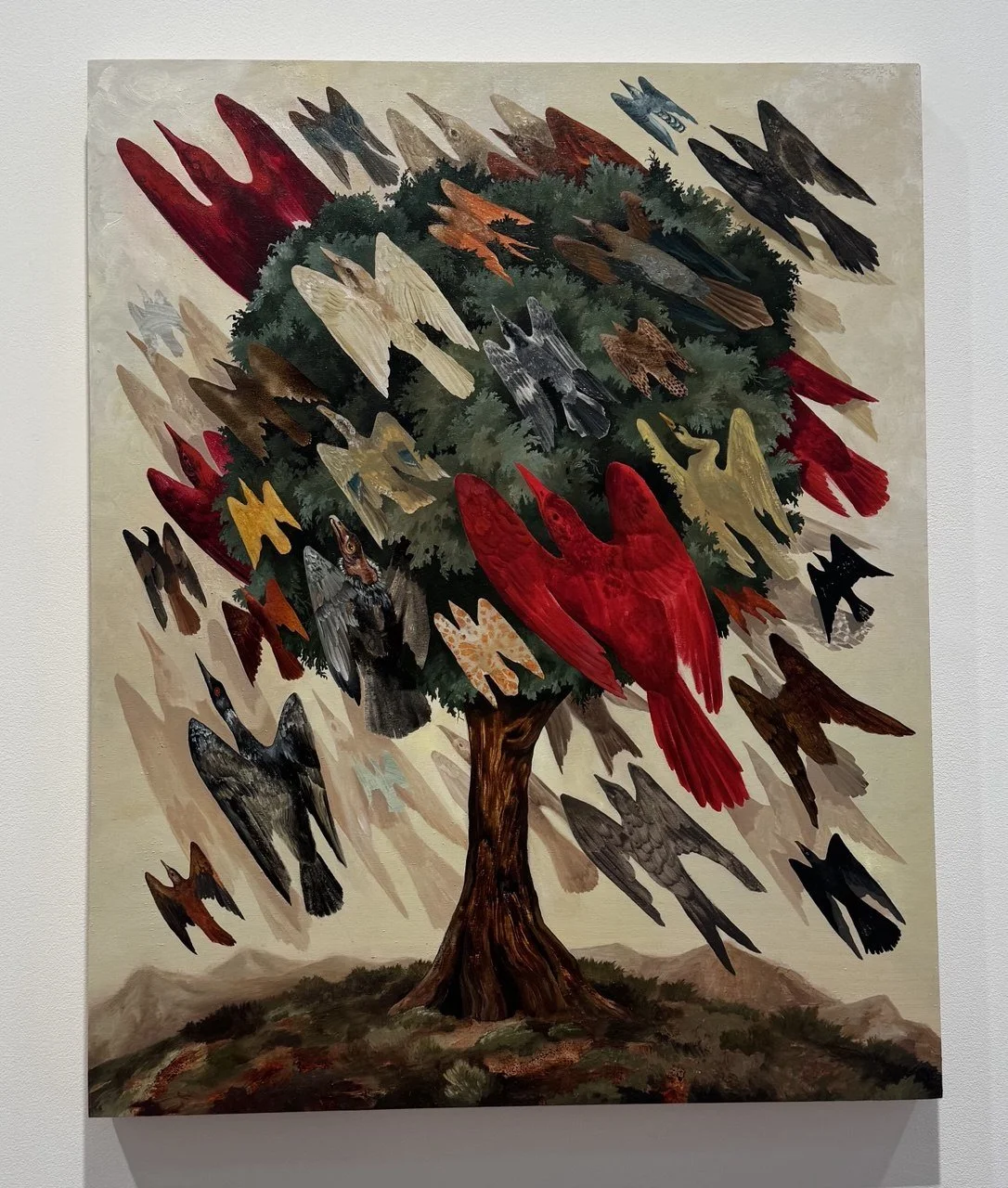
Kat Lyons, The Augurs (2026), installation view, Pilar Corrias, 2026. Photo: Art & Butter.
Owl
Because the owl is a creature of the night, it has often been associated with darkness, mystery, and death. In Māori, Babylonian, Chinese, Japanese, and Hindu traditions, owls can carry ominous or supernatural meanings. At the same time, the owl is also one of history's most recognisable symbols of wisdom. In Greco-Roman mythology, it was the attribute of Athena (Minerva), goddess of wisdom, learning, and strategic warfare. During the Renaissance, owls could additionally appear as allegorical symbols of sleep and contemplation.
Peacock
With its spectacular feathers, the peacock has long been associated with beauty, royalty, and magnificence. In India, China, and Iran, it became a symbol of imperial power, while throughout Asia and Europe it was admired as an emblem of elegance and majesty. In Japan, peacocks were linked to Buddhist deities and came to symbolise good fortune. Their numerous feather "eyes" associated them with fertility, abundance, and protection. In Greco-Roman mythology, the peacock was the sacred bird of Hera (Juno), queen of the gods. According to myth, the eyes on its tail originated from Argus, the hundred-eyed giant whose eyes were placed upon the bird's feathers after his death. In Christian iconography, peacocks symbolised immortality because their flesh was believed not to decay. Further, their star-like "eyes" patterns on their feathers made them symbols of heaven itself.
Phoenix
The phoenix is a legendary bird that lives for 500 years before perishing in flames and being reborn from its own ashes. As a result, it has become one of the most enduring symbols of renewal, transformation, and rebirth. In China, the phoenix symbolised virtuous leadership and was associated with the empress. It was regarded as one of the four sacred guardians of the universe. In Christian art, the phoenix became a symbol of Christ's resurrection and the promise of eternal life.
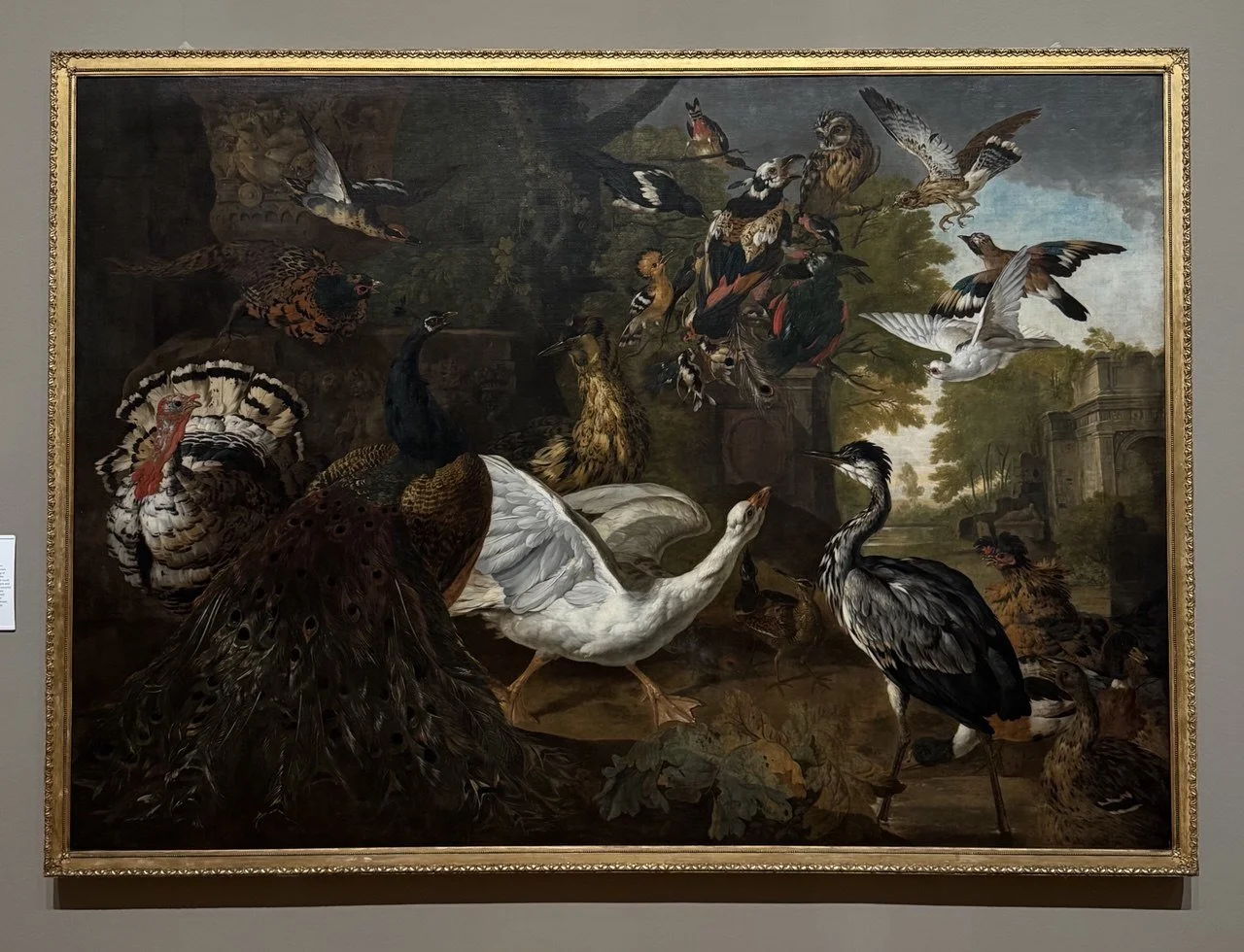
Pieter Casteels, A Fable from Aesop: The Vain Jackdaw (1723), installation view, Tate Britain, 2026. Photo: Art & Butter.
Falcon
Falcons have long represented nobility, prestige, and heroic virtue. In Europe and Asia, they frequently appear in portraits of rulers and aristocrats, reflecting the elite status of falconry itself. Their remarkable eyesight, speed, and ability to fly at great heights made them symbols of ambition, leadership, and spiritual elevation. In both China and Japan, the word for"falcon" is associated with ideas of heroism and courage. In Ancient Egypt, the falcon held particular significance through its association with Horus, the god-king often depicted either as a falcon or as a man with a falcon's head.
Crane
The crane is one of the most celebrated birds in East Asian art. In China and Japan, it appears throughout religious imagery, poetry, painting, and decorative arts. Its graceful movements, particularly its elaborate mating dances, made it a symbol of elegance, refinement, and spiritual elevation. The crane is also associated with longevity, personal ambition, and enlightenment. Because cranes fly at great heights, they were believed to guide souls to heaven and act as messengers between the human and divine realms. In Europe, the crane could symbolise vigilance and duty, based on the belief that within a flock one bird always remained awake to stand guard.
From the dove's promise of peace to the phoenix's cycle of rebirth, birds have helped artists visualise some of humanity's most enduring hopes, fears, and beliefs. Their ability to soar above the earth has made them powerful symbols of transcendence, connecting the physical world with the spiritual, the mortal with the eternal.
Based on Matthew Wilson’s Symbols in Art